If you’ve ever stopped drinking alcohol for any length of time, you know how unsupportive people can be — especially if your reason for stopping is anything but alcoholism. Why? Because no matter how nonsensical poisoning our bodies with alcohol is (and yes, the science is settled by now), the fact that you chose differently puts your friends in a difficult position: give you shit about it and feel good, or question their own judgment and feel something other than good. Our brains are wired to avoid the questions that lead to uncomfortable feelings — shutting them down is the path of least resistance.
So let me be the friend who makes you uncomfortable.
Is AI addictive? My claim is yes. My own experience says yes. But let’s backtrack for a minute and see if we can build that case.
The model
Let’s start with the experience of building with AI. Whether you use the terminal or a desktop app (I personally love Conductor.build), building with AI takes this form: small action + variable reward + investment. The small action is the short prompt you write. The variable reward is whether it works or not. The investment is testing the AI’s work, creating loops, paying expensive subscriptions. Now let me introduce you to the Hook Model, a four-step behavioral design framework created by Nir Eyal in his book Hooked. This is the exact same model used by social media platforms — the apps that hooked the average American for 4.5 to 5.5 hours a day.
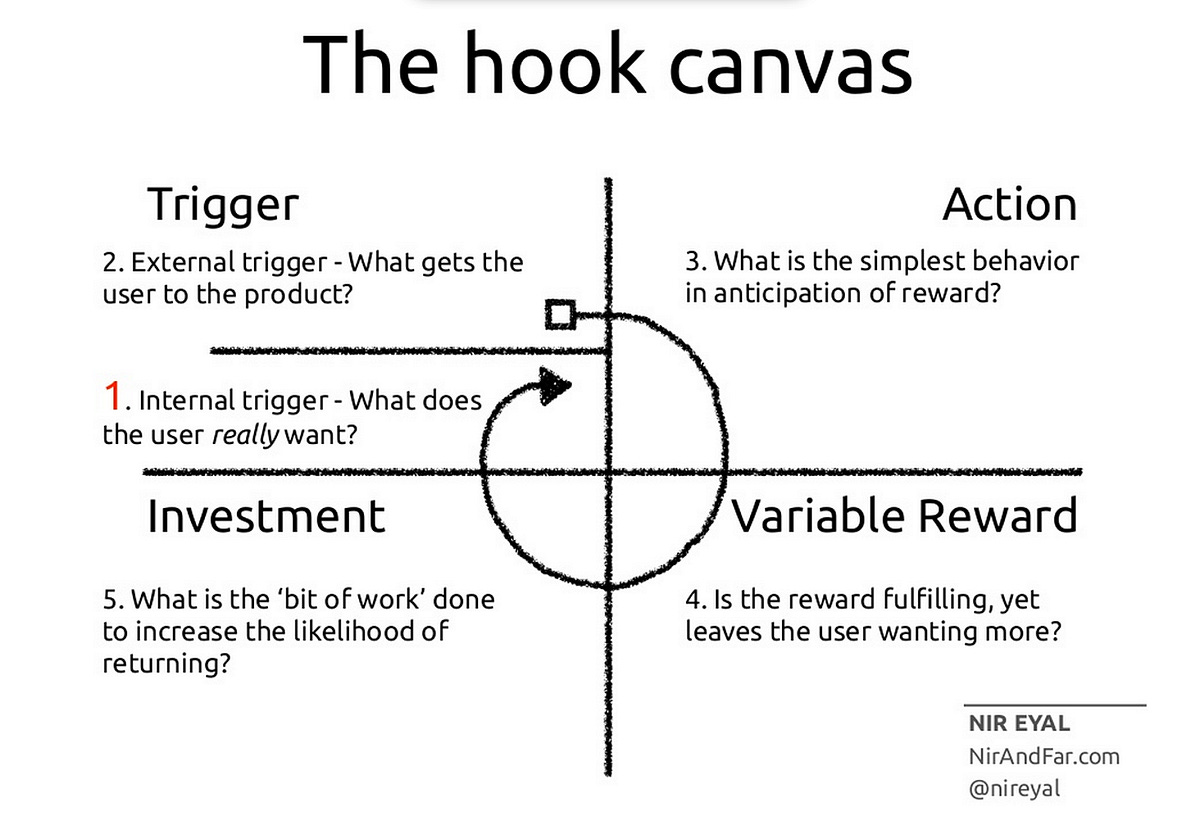
The process
However you started using a coding agent, it likely scratched an itch. For early adopters, that itch was an internal trigger (step 1 of the hook model above). For me, it was two things: regretting not going to engineering school, and spending my early career managing teams of engineers — so costly that my main job as a founder was finding money to pay them instead of doing the fun building part. Whatever your reason, everyone around me who started — especially my founder friends — got hooked. And hooked hard.
Go to any AI meetup and feel the energy: everyone joking about how addicted they are, the same way my childhood friends used to brag about how much they drank. In typical addiction fashion, as your behavior starts looking odd from the outside, you find a group going through the same thing — one that supports and comforts you in your addiction instead of challenging it.
To make things worse, public examples aren’t hard to find. Garry Tan, CEO of the famous Y Combinator, proudly told a SXSW audience last year that he has “cyber psychosis” and barely sleeps because he’s so excited to be working with AI agents. Everyone applauded.
The relation with ADD
It’s no secret that many founders have ADD — diagnosed or not. I’ve mentioned this before: ADD is a dysregulation of the dopamine system. Your brain doesn’t produce enough dopamine → you chase high sources of dopamine → high sources of dopamine desensitize your dopamine receptors → and around it goes. That’s the vicious circle of addiction for ADD brains. But remove the first two steps and you get the exact same circle. Having ADD makes you far more vulnerable to dopamine addiction, but dopamine addiction can happen to anyone — if it couldn’t, only people with ADD would be addicted to social networks. Fun fact: people with a strong dopamine addiction display symptoms remarkably similar to ADD: impulsivity, escalation, brain fog, mood crashes.
The consequences
This is where I’ll lean most on my own experience, since studies and public accounts are still scarce. Here’s how the vicious circle played out for me (in no particular order):
Building with AI felt very, very good — so good that I was excited to wake up and go check on my agents.
Stopping was hard. This led to overwork and poor sleep hygiene. Most days I worked 12 hours, 6 days a week — a first in my life. Many of my friends lost all sleep hygiene in a way eerily similar to what you see with gamers.
As the circle deepened, getting out of work mode became difficult. It was hard to focus on the present moment. My brain never stopped running, even while sleeping, and being present became a struggle.
The mood crash was very real whenever I finally stopped working: a deep sense of emptiness, no matter the objective quality of my life. This made the loop stronger — I often went back to work just to feel better.
As I became an AI expert, nearly every area of my work ended up AI-driven, making it nearly impossible to work on anything else.
AI becoming my work gave me the perfect alibi for falling deeper into the circle whenever friends and family questioned my mental health.
I’m not here to lecture you or claim I’ve figured it out. I haven’t. Regulating my AI use (yes, I know how that sounds) is a daily struggle, and it’s too early for me to give advice on how to build a healthier relationship with AI (hopefully there is one). I’m here because I’m sure some of you are ready to hear this and start asking: is this healthy?